

One of the greatest moments that all of humanity recently experienced was the successful conclusion of the Artemis II mission, which took Commander Reid Wiseman, Pilot Victor Glover, and Mission Specialists Christina Koch and Jeremy Hansen (basically four of THE COOLEST PEOPLE EVER) around the Moon and back for the first time in over 50 years. These four people (and thousands more at NASA) collectively made a few giant leaps for humanity, yet, when these thoroughly intelligent individuals were asked about this mission’s legacy, Astronaut Christina Koch said, “I hope they forget all about Artemis II.”
And this statement honestly threw me into a little tailspin for a bit right there. For the longest time, even though I never wanted to succumb to the pressure of building a legacy, I always put in the work to leave a meaningful one. I even talked about this pressure in a past newsletter issue four years ago. The 21-year-old me from back then was a different person than the 25-year-old me today. And the me of today wants to revisit the meaning of legacy and to understand where along the way it changed (or did it?)
Has the meaning of legacy changed?
The last time I talked about legacy, I used Merriam-Webster’s definition of the word:
something transmitted by or received from an ancestor or predecessor or from the past
I talked about time, about how I have essentially been trying to fix the problems of my past for other people’s present to better their (and my) future. I talked about the uncertainty of time and how it overwhelmed me today. I even talked about “legacy-building” as a positive-sum game and how I had to shed the pressure of leaving something behind for those who come after me.
However, I always thought that legacies were driven by intent. I believed that even if I was to forego the pressure of wanting to leave something, I was still supposed to leave something behind.
Last year, I had the opportunity to visit the University of Toronto, where I passed by the Fisher Rare Book Library, the largest publicly accessible repository of rare books and manuscripts. One of the crown jewels of this library (my words, not theirs) is a copy of Isaac Newton’s Principia, which, among other things, gave us the three laws of motion and the law of universal gravitation. If you are a person of science, this is one of the most important works produced in the history of science.

And yet, I can guarantee without a doubt that Newton did not write Principia because he wanted to leave something behind for the rest of us. Rather, it was the outcome of his attempt to improve our understanding of the world we live in, and it ended up laying the foundation of modern physics.
That is exactly what I misunderstood about the concept of legacy. Legacy isn’t the end-goal of our purpose; it is the consequence of it. We can’t choose to leave a legacy, yet everything we do will be summarised as our legacy one day.
Can any legacy last forever?
Well, if we’re still talking about Newton’s Principia, it is easy to assume that legacies are static, that they are infinitely immortal tombstones that stand through time even if they are forgotten. But Newton is the exception here, and most people’s legacies fade and eventually perish. And this is exactly where we must remember the words of Astronaut Christina Koch once again. I don’t believe that the right question to ask is whether our legacies can last forever. I think it is more important to ask what it even means for a legacy to last forever.
I promise you I’m not being cynical or nihilistic in any way. This isn’t one of those statements. I believe each one of us either defines or discovers a purpose that we then try to fulfill for the rest of our lives. A lot of us discover this purpose looking backwards, not forwards, but most of us discover it someday. And some of us do worry about the fulfillment of our purpose, but very few care about the scale of it.
Steve Wozniak just wanted to be a lifelong engineer, building computers just for the love of it. In 1976, he showcased the Apple I at the Homebrew Computer Club in Palo Alto, which kick-started one of the greatest institutions in the tech world. And then in 1977, he released another computer, for the first time in the consumer market. This little device was called the Apple II; it pioneered plug-and-play computing, came with one of the first popular business applications (VisiCalc), and, all in all, transformed computing from a hobbyist's niche into an accessible consumer appliance.

On April 11th this year, the Apple I turned 50. The two most digitally enabled generations ever, Millennials and Gen Z, were not even born then. Sure, lots of them recognize Woz as the co-founder of Apple. But the number of humans who actually understand how vast the impact of Woz’s work has been is abysmally small. We live on our computers today (and yes, smartphones are computers). We interact with our friends and family on chat platforms, post our opinions on social media, buy groceries and other necessities on e-commerce platforms, manage payments through e-banking platforms, watch movies and TV shows through streaming platforms, book our flights and hotels through travel platforms, and I continue on and on without a pause for rest because that is how essential computers are to our lives today. None of this happens if personal computing doesn’t exist, and that is what Woz pioneered.
Maybe that is what legacies were always supposed to be like. It should not matter who planted the tree, but that the tree was planted.
Life is a glorious burden, indeed.
Not too long ago, I read this book by Albert Camus called “The Myth of Sisyphus,” which introduced his philosophy of absurdism. In very brief words, it explores this contradiction in how humans have this desperate urge to find meaning and purpose in an indifferent universe that cannot inherently offer any.

One of this book’s core pillars is the story of Sisyphus from Greek mythology, who was punished by the gods (for repeatedly defying them) to roll a massive boulder up a steep hill and watch it roll down before reaching the peak again and again for all of eternity. The closing line of Camus’s analysis of the story of Sisyphus is one that I often think about:
One must imagine Sisyphus happy.
Most of our lives are just as absurd as the punishment Sisyphus endures. We may not have been punished by the more traditional gods, but we all constantly serve the expectations set by our friends, our families, and, even more so than others, strangers in society around us. We chase status and acquire symbols, and we push our boulders every single day to achieve what we believe we need to. And those wins come with only a fleeting sense of accomplishment because, since when did any of us not have miles to go before we sleep?
Sisyphus is not a tragic hero, though. He knows that his turmoil is endless, that the boulder will never reach the peak, and still, he participates out of defiance. At that point, he accepts his fate and chooses to be stronger than his rock. And there is something very freeing about that.
The truth is that the universe will never care about the monuments we’re trying to create. It will not pause for our ambition. It will not applaud our suffering. It will not preserve our names just because we worked hard enough, loved deeply enough, or tried to become the kind of person worth remembering. The sand will swallow our footsteps. The hill will remain. The boulder will roll back down.

And still, we should push. Not because the burden becomes lighter, but because the act of pushing is where we prove that we were here at all. Our lives are a burden because we want meaning and purpose in a world that owes us none. But even after knowing this, if we still care and fight for the purpose we choose, it does become a glorious burden, indeed.
Maybe legacy is not meant to be chased. Maybe it is simply the shadow cast by a life that keeps pushing with purpose. Some of our footsteps in the sand will disappear before anyone else notices them. But you and I would still know they were there. We would still know that we made them. And maybe that is enough for them to have mattered.
A final salute.
Being forgotten is not the opposite of leaving a legacy. It is proof that the world kept moving because we helped push it forward. So here’s to Christina Koch, Reid Wiseman, Victor Glover, Jeremy Hansen, and everyone who made Artemis II possible.
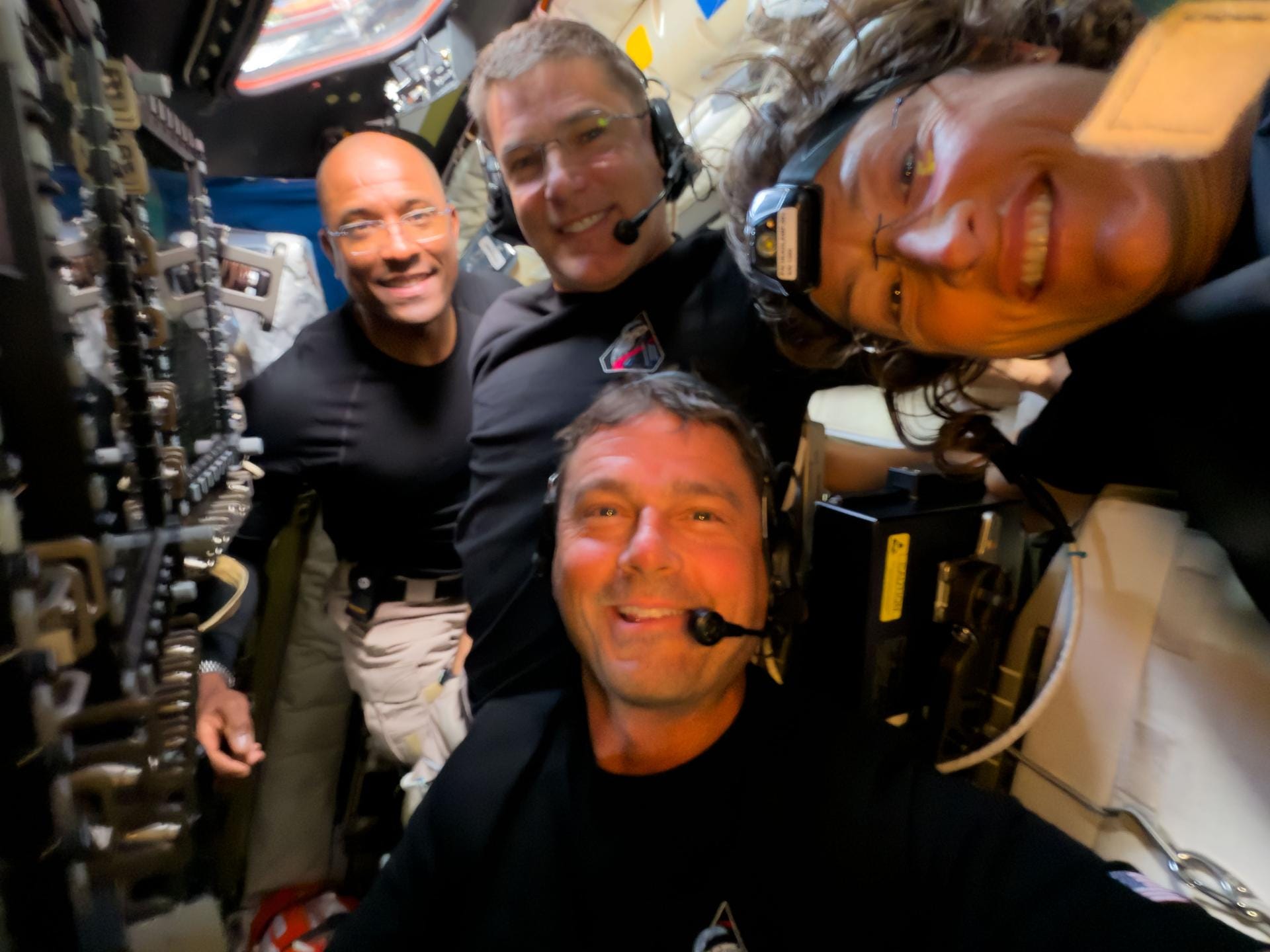
Thank you for reminding us that hope and purpose are not always found in certainty. Sometimes, they are found in choosing to move toward the treacherous, the distant, and the unknown anyway. Thank you for helping us look at the darkness of space and still discover beauty, courage, and a reason to keep reaching.
I hope we do forget all about it someday, not because it did not matter, but because it mattered enough to help make the extraordinary feel ordinary for everyone who comes next.
I am curious, do you feel some kind of gratification when you help or guide someone?
If you do good work but it leaves no impact on anyone, no one validates your effort, does it effect you?
______
Love the Newton mention. Recently I was reading about the stages of discovery in modern physics and got to know what being a student of science really means.
Why you have to understand the past to create a new understanding for the future.
To quote it directly "in 18th century, Newton constructs modern physics. He imagines all objects have a natural motion (an idea of aristotle) at a constant speed (an idea of Galileo) in a physical space described by Euclidean geometry (an idea of his own"
— from White Holes
_______
To me, legacies don't seem to be static. Newton is very very recent like 300 years ago.
Sooner or later someone will find exceptions or falisify Newton's equations.
Which kind of already happened with quantum mechanics with Heisenberg & Schrodinger in 1920s (100 years ago)
Newton has a strong tombstone but time can bring every legacy to dust. A faraway story.
His mentions in books will go from chaptees, to a few pages, to para to one sentence. Father of something something.
______
One must imagine Sisyphus happy.
Super curious now.
______
It was such an interesting read. I got carried away. Thank you:)
I read this essay for the first time around a month ago. I read quite a few times since then. It's undoubtedly one of the best pieces I read this year. Your main argument, different anecdotes, the flow from one story to another, and the switch to Absurdism to connect legacy, work that we do with Camus' philosophy is my favorite part of all.
Personally, I feel even Newton must have felt that his name should be written beneath the laws he discovered. Steve Wozniak must have felt that people who are using Apple I should know who created it. But zooming out to decades and centuries long duration, I believe they mustn't have thought of leaving behind a legacy... they just did what they are best at. they performed their duties.
Camus tells us to rebel against absurdism, saying that life has no inherited meaning. If the universe has no meaning, there isn't a point figuring out what's the meaning of life. But this keeps US responsible for creating meaning through our actions. Your take, that people around you notice and care about your actions even if the universe doesn't, is really a new perspective I found after reading Camus for over three years.
Last few paragraphs reminded me of the classic Karm Karte Raho Parth, Phal Ki Chinta Na Karo from Bhagwadgeeta's second chapter. I believe it fits in perfectly with your core message.
Excellent read as always, keep writing bhai!! <3