

The first time I left home was in 2012.
I was just about to start Class 7, and I had been accepted into The Doon School back in Dehradun. I was excited, not scared: my dad is an alumnus, and I had grown up on his stories. Taare Zameen Par had made boarding school frightening for a lot of kids back then, but that wasn’t going to be me. Eleven-year-old me felt ready to walk into the Main Building and live in the rooms of Tata House where my dad had spent his own childhood.


I still remember the day of joining. It was a grand affair, welcoming children and parents from across India into the ethos and legacy of Doon. What I never expected was that it would be a farewell to the home I knew growing up and to the person I had been all my life.
Fourteen years later, the person that farewell made is the one writing this. He is tougher and more ambitious than the boy who walked into that building, and everything he has achieved so far would make that boy very proud. He also paid for it, and he is still paying. Most days, I think it was a fair trade. I have never been certain enough to stop asking.
Leaving home is “a” death of the self
You see, no one who leaves home returns the same. As an adolescent living eight months a year away from the home I grew up in, I learned quickly that the world outside asks for a competitiveness the world inside never did.
Leaving home taught me to be difficult. It did not make me cruel, or even loud for the sake of it, but it made me willing to be the person who disagrees. I learned to sit with an argument without needing it settled immediately, to inconvenience people for what I deemed worth the inconvenience, and to accept that some of them would think less of me for it. Nobody has ever won anything they cared about while being easy to deal with.

And that’s the one thing I never had to do as a child coming from privilege. Until Doon, I was the ideal soft-spoken kid who never raised his voice without being prompted (let alone do so out of turn). That kid had so much love and security that he never needed to fight for anything. I am still loved and supported; what changed is that leaving that security taught me to stand up for myself in a way I never would have.
Inside a cocoon, the caterpillar releases enzymes that break down most of its old tissue into nutrient-rich fluids that then help build its new body, one that can fly. Every leaving has been a cocoon of some kind, and Doon was the first. It destroyed parts of my personality to strengthen me for the world outside. A kid entered that place, but that kid never left.
Every bubble looks like the world from inside
The second time I left home was six years later, when I moved out of my city for college to Amity University in Noida. There was no Main Building this time (just E-Block), no legacy to walk into, no grand affair. I packed and went, assuming I already knew how this worked.
Doon had been a bubble, and I only found that out once I was outside it. You see, Doon kept generating opportunities, open to everyone, each with a safety net under it. You took them because you wanted to, or because everyone else was and standing still was not an option. Amity showed me a very different spectrum of privilege. While some were far more comfortable than I had ever been, others had arrived with much less and were grittier and hungrier than anyone I had competed with at school. I had spent six years in school learning to be the best in the room (at least the ones I chose to walk into). At Amity, the world was wide open, and I had to decide which direction to walk in.
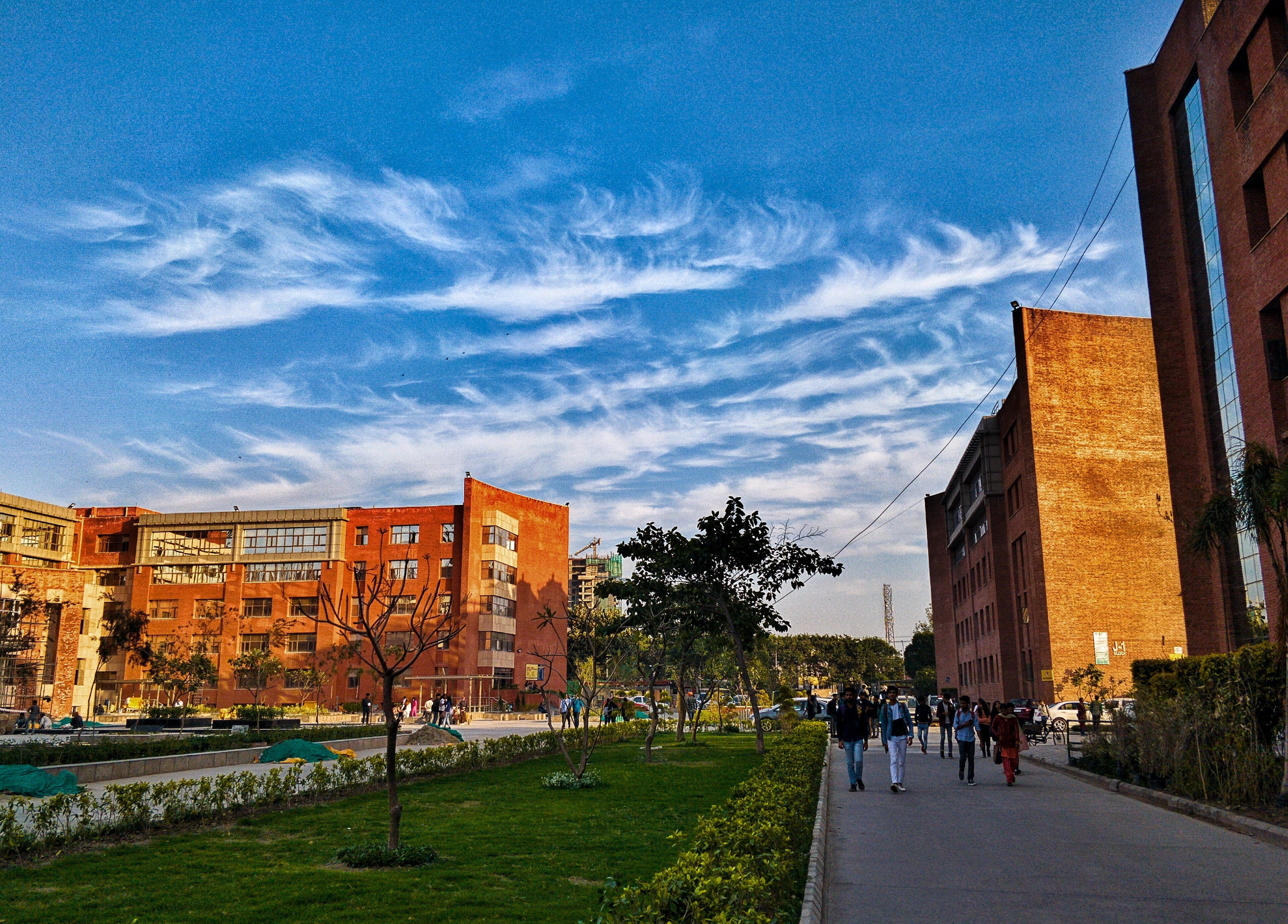

Unlike at Doon, where the opportunities were laid out in front of you, at Amity I started picking my own fights. I joined a couple of the department’s tech clubs on Day 1, which also happened to organize our annual tech fest and hackathon, because I thought only going to class would be too boring (Doon had instilled the restlessness and made me a somewhat decent communicator and operator). And for a while, it actually worked out perfectly! The success we achieved in my freshman year, combined with my relationships with certain department seniors and faculty, made me think I was golden and untouchable. Unfortunately, somewhere among all the virtues Doon gave me, I had also picked up a “teeny tiny” bit of arrogance. By my sophomore year, I was far enough into it to be running past the college’s recommended limit on official duty, which was how the college let us count hours spent organising as class attendance.
I thought I was climbing to the top of the mountain. What we got instead was an avalanche. Amity’s official duty system was being abused on various fronts, and all of us were called in for questioning by a disciplinary committee. All the work I did that year was invalidated in a moment, and I almost got suspended. The boy who left home in 2012 would not have recognised the person in front of that committee. I am not sure he would have liked him.
Over time, I learned to ask whether the work was worth doing at all, and not just whether it would get me ahead. Doon had trained me to be excellent inside a pre-existing system, and it had never occurred to me to question the design. Amity was where I learned that the system itself could be wrong, and that winning a fight is not the same as being right to pick it.
The fighting always has a price
Back in Class 10, while I was still very much inside the cocoon, I read a poem by Dylan Thomas called "Do Not Go Gentle into That Good Night." The first stanza goes as follows:
Do not go gentle into that good night,
Old age should burn and rave at close of day;
Rage, rage against the dying of the light.
Thomas wrote this as a prayer to his dying father, a call for strength in his final days. However, it piqued my interest because it sounded very similar to what Doon was teaching me: don’t go quietly, don’t be mediocre, fight for your place. At fifteen, it really did sound like an instruction.
What took me longer to notice was that the instruction was never the hard part; the price was. Thomas was begging his father to resist death, to refuse to go quietly out of a life he was losing. Although not as explicitly, Doon asked me to survive the death of a soft-spoken boy and keep walking as someone more weathered, more outspoken, and much quicker to put himself first. The end of a childhood is not the end of a life, and I have no interest in pretending otherwise. But a version of me did fade away in those years, and I did not think think to mourn him for a long time.
When I remember the poem today, it forces me to acknowledge what it costs to rage every day, for years, at things much smaller than death. The truth about being your own person is that the fights keep arriving, and we don’t get to choose which day they turn up. Some belong to our work, some to our families, a few to ourselves. It takes an unreasonable amount of hope to believe each one is leading somewhere better.

And the fighting always exacts a toll. Sometimes it is physical; there are days I come back from work and crash on my bed, unable to get up for a while.
Some days the toll is emotional, and this is the part of myself I like least. When enough of it piles up, I snap at the people closest to me, usually over something that has nothing to do with them. The real reason is never whatever I am snapping about. It is that somewhere along the way I decided the whole load was mine, that nobody was coming to take any of it, and that anything I set down would stay down. In the middle of it, I genuinely cannot see the people standing right next to me, offering support. So I take it out on them instead of asking them for anything, which is, in the simplest words, utterly idiotic. I don’t think that is strength anymore. It is a habit I picked up somewhere between eleven and now, and I’m trying to do better. I still fail every now and then but I am trying.
Nowadays, I try better to remember that what keeps me standing on my bad days is often just the people who love me for who I am and forgive me for who I am not. I am still the one who has to keep track of what I’m actually fighting for, because a fight whose reason you’ve forgotten is only suffering. But I am doing better at asking for help when I need, especially from those I trust.
You have to mourn who you were
When I lose the thread, I go home. I didn't consider home as a refuge for a long time, because as a child, home was the security that meant I never had to fight; it was the very thing I had to leave to become someone who could. But home is not only a shield. It is also where you go to put yourself back together, and to be reminded of what you were fighting for in the first place. The cocoon is not a place you can climb back into, but home, thankfully, is.
Which raises the question I keep coming back to: should the butterfly mourn the caterpillar? That path of evolution produces something beautiful, but it is brutal and destructive to get there.

I think it should.
Mourning the people we were, the children we were, is how we get to love them and forgive them. I cannot go back to being eleven, and I would not choose to. Mourning him is not the same as wanting him back. It just means I stop treating him as a rough draft of me.
That is what going home is for now. Home was the security I had to leave in order to become someone who could fight, and it is the only place I have found where nobody needs me to keep fighting. I go back, I stop for a few days, and the boy who left in 2012 is easier to find there than anywhere else. Then I leave again, because the life I chose for myself is out here. The difference is that I know what I am leaving now, and that it will be there when I need it.

Oh my God! This is so well written 😭🤌
Fantastic essay Aditya!