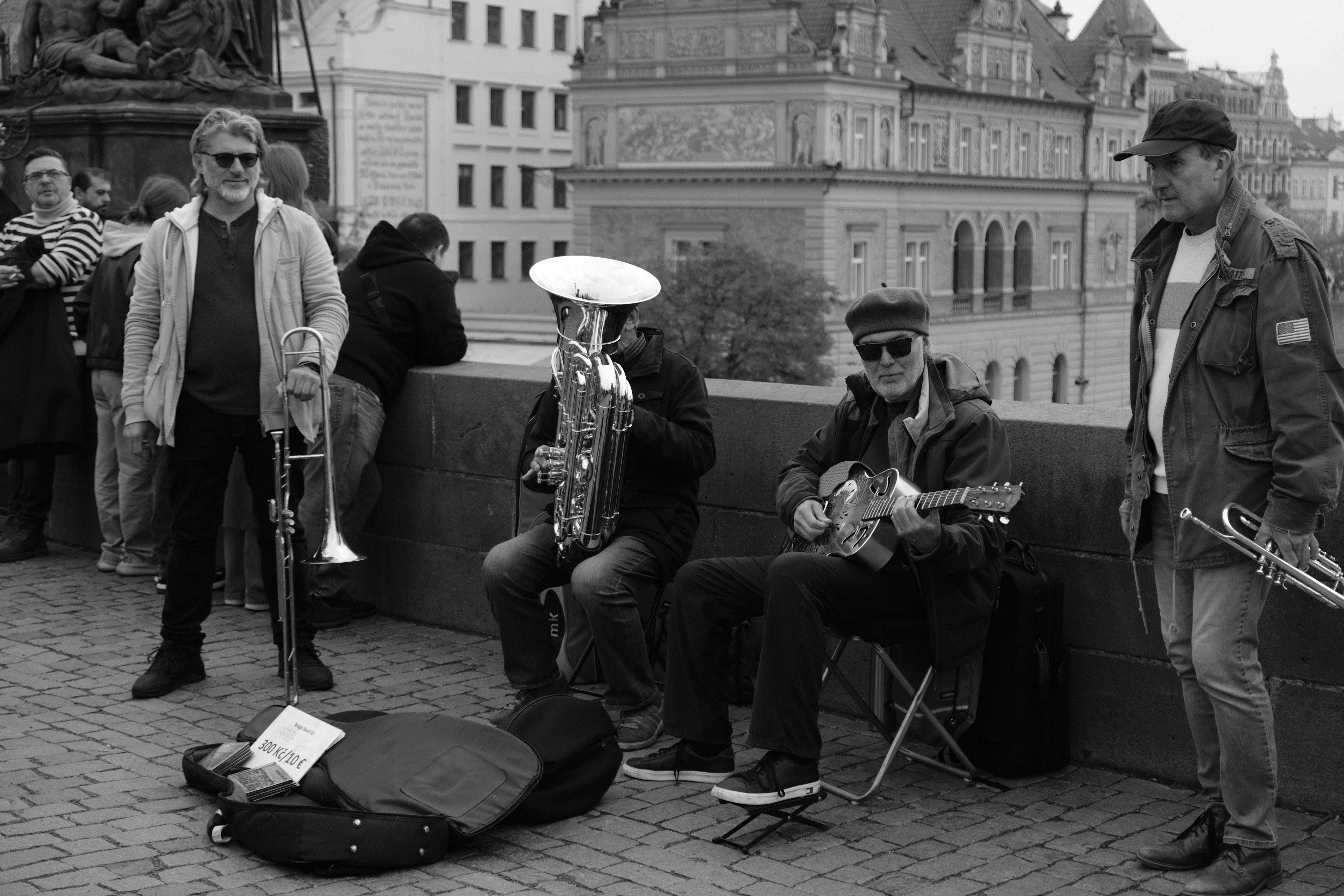
Anyone who knows me knows that I absolutely love photography! My first experience with the camera was with a single-use film point-and-shoot as a kid. Eventually, I borrowed my dad’s Sony Cyber-Shot digital point-and-shoot to take on treks back in school. Once I got my first smartphone, I shot a lot throughout college, both on campus and around Noida and New Delhi. For the last couple of years, I’ve owned a Fujifilm X-T30 II mirrorless camera, and I’ve been photographing the streets around me on my travels and in my day-to-day life, from Bengaluru and Jaipur to Prague, Toronto, and beyond. My hobby has also included heading out on photo walks, some of which I organize myself.

About a month ago, I shared my clicks from one such walk on Twitter. Within 24 hours, a post popped up in my feed calling out street photographers for what they do, how invasive it is, and how it intrudes on the personal lives of people around us. It hurt. Street photography is something I love to do, and the post felt like the opinion of someone with no experience in this particular form of photography.
It did, though, make me pause and wonder whether those words held any real value. In my opinion, they did (a lot, actually). Street photography can intrude. It brings out a tenacity in people who choose to step into the bustle of everyone else’s daily life to capture how the world walks around them. It’s a world that includes people, vehicles, animals, buildings, busyness, struggle, toil, love, hatred, suffering, kindness, and so much more.


What it made me realize was that maybe this commentary came up because a lack of experience kept this person from appreciating this form of art. Therefore, I thought it was a good time to talk about why I indulge in street photography and why it has value, no matter how intrusive it may seem from a third-person perspective. I also asked a few fellow street photographers why they do it, and their answers echo a lot of what I feel.
Disclaimer
Street photography is legal in public spaces in India and many other countries. I don’t photograph people in toilets, changing rooms, or any other space where they can reasonably expect privacy. That isn’t street photography; it’s voyeurism, and it’s a crime.
Objectivity and transparency
In all my time photographing the streets so far, I’ve discovered the vastness that exists in a world that may seem constricted and confined. I’ve had the opportunity to observe how life flows, how people move, how work happens, and how the rest of the world coexists around us.
Deepthi Balasubramanian: “What I particularly love about street photography is how it captures the character of a place. The streets, people, little routines and ordinary moments tell you so much about what life looks like in that location.”
Street photography, however, lets me capture moments of honesty as transparently as possible and extend them to the world beyond me. That could be the smile of a person waiting in traffic at a red light, a lady sitting next to her little jewellery and watching reels on Instagram before her next customer arrives, or an auto driver who’s just pulled up in front of me and stared into my soul.


In many ways, it’s been the only truly honest depiction of life around me. When we look at life around us, whether we’re sitting in a nice little restaurant or cafe, scrolling through our friends’ social media, watching a random podcaster vlog about their travels on YouTube, or reading the newspaper, what we always see is a curation of specific brands and tastes (which we then adopt and seek). None of these are truly objective, because they’re people’s perspectives. They’re experiential. That doesn’t mean they aren’t true. They just have to be subjective (by their very nature).
Most people crave curation in life. The streets do not offer any.
Vikram Dewangan: “Street photography gradually changes the way you look at ordinary things. Things that might seem mundane or insignificant in everyday life start appearing interesting when you look at them through a photographer’s perspective. You begin noticing little details, human interactions, patterns, movements, and moments that you would otherwise overlook.”
When I share my photographs, they become my subjective experiences and perspectives again. But I’ve had the chance to experience objectivity, and that’s more than can be said for most people around us today.
Do we care about the aesthetic?
Another major criticism I see is that street photographers tend to romanticize the struggles of the world around us. If you think these acts are purely for the aesthetic, I advise you to spend a few hours walking through downtrodden suburbs with dilapidated buildings or bustling markets with laboring people. Then explain to me how you keep your heart from breaking and still capture things solely for the aesthetic.


We don’t capture struggle because it’s beautiful and worth romanticizing. We do it because it deserves to be documented. Without these discoveries and pictures, no one outside these little microcosms gets the chance to understand where these problems exist.
Nehal Joshi: “The subtle, quiet, and sometimes chaotic moments draw me in. There are so many stories waiting to be seen, experienced, and told.”
At the same time, of course, the aesthetic matters. As humans, our brains have evolved to appreciate visual and sensory beauty. So for most people, only when they can appreciate an image's aesthetic do they allow the content to evoke certain thoughts or emotions within them.
If the picture’s aesthetic fails, what it documents goes unseen, too.
The world often shows us its most beautiful creation and devastating destruction together. Sometimes we see it in objects. Sometimes we see it in people. Sometimes beyond both. As a photographer, I must, at the very least, attempt to represent this duality as truthfully as possible.
Everyone deserves to be seen
This need to document brings me to one of the most important reasons I love photography. Most of us live our lives with a certain momentum toward our individual goals and desires. Eventually, those goals grow into catering to the people we love, the people we care about, the people we’re supposed to serve, the people who rely on us, and so on. Very few of us are actually seen by the people we support.
Tejal Kapil: “I think that’s what street photography has always been for me. Observing, imagining, and finding little stories in moments that most people might simply walk past.”
For example, Diwali just passed, and many people I know bought flowers in bulk to decorate their homes for visiting friends and family. If you were one of them, do you remember the person who sold you those flowers? Also, when was the last time you really saw the delivery partner who brought your Swiggy, Zomato, Blinkit, or Zepto order?


I’m not saying we don’t care about these people or that we try to ignore them. But it’s okay even if you do, because most of these people aren’t really part of your life. They fulfill minuscule purposes and move on, and we all do the same for plenty of others. That doesn’t mean a person should go unseen.
I want to share an experience. I was walking through Commercial Street in Bengaluru when I noticed a footwear vendor drinking tea, and they caught me clicking their photo and called me over.
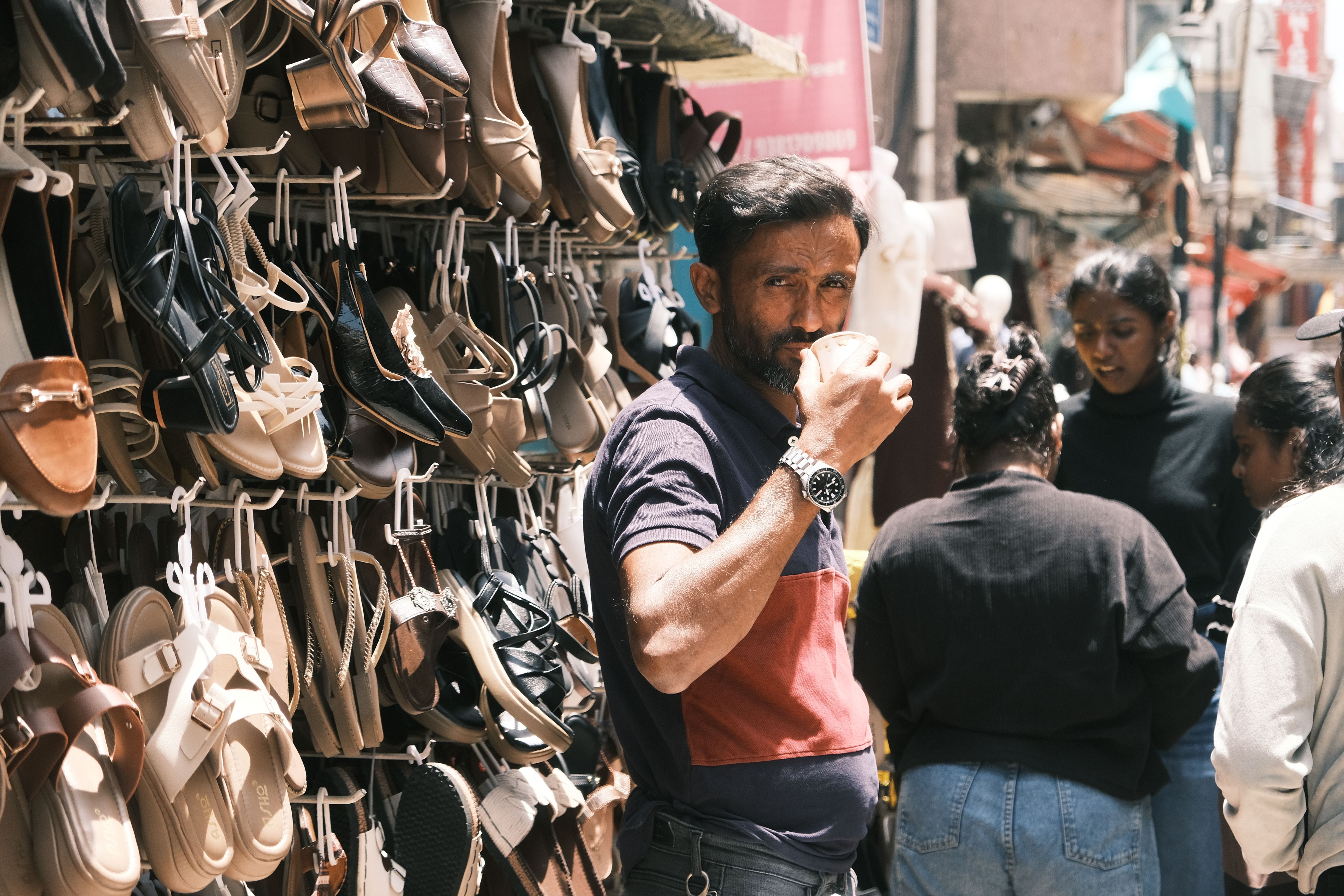
For a second, I was afraid of having offended this individual. However, he called me over out of sheer curiosity, and he liked his picture so much that he asked me to take a couple more and share them with him (which I did).
Aishwarya Mangipudi: “If someone gives eye contact while you photograph, it makes you somehow accountable to make them feel you are just trying something good.”
He appreciated that someone, while he was out there persevering in the sun, thought he deserved to be seen and retained as a memory, as a remnant of a circumstance they had observed and experienced.
We don’t shoot people because intruding on the busyness of their lives is inconsequential in the pursuit of demonstrating our taste. We participate because everyone’s life matters, and everyone deserves to be seen, no matter who they are or where they come from.
The truth is that we all have a limited amount of time on this planet. And, in some way or another, even if only temporarily, we all leave a few footsteps behind. So what if the footprints eventually fade away? What matters is that they were there in the first place, and everyone’s footsteps should be seen. The greatest tragedy for me as a street photographer is that I can only capture so many.
Pride and ego
My concluding thoughts are a bit paradoxical because this article came from a place of egoistic tenacity about my opinions around street photography, yet ego is the last thing you can have when you’re out capturing the streets.
As a street photographer, while I stand proud of my work, I must be humble and respectful of the world around me. We cannot afford to be disruptive. All we can do is be little rocks that stand still in the middle of a river flowing around us, capturing the people in boats drifting past, the fish swimming through, and the other pebbles that get ground down to silt or carried downstream. Sometimes that’s all there is to life, the world, and everything in between.
Vivek Nigam: “When I’m on the street, I wish to be like the wind which moves past people without ever confronting them head on. The photos from street photography capture more than just pixels. They contain the observation of an artist, the curiosity which made their eyes drift to a direction, the headspace they were in. And that arrangement of the universe will never happen again. In that moment, I capture the world as how I’m seeing it, cause it’s my world as much as it’s anyone else’s.”
The world is truly filled with music if one is willing to be patient and listen with open ears. Maybe that’s all that matters.